


Family Edition
Family Edition
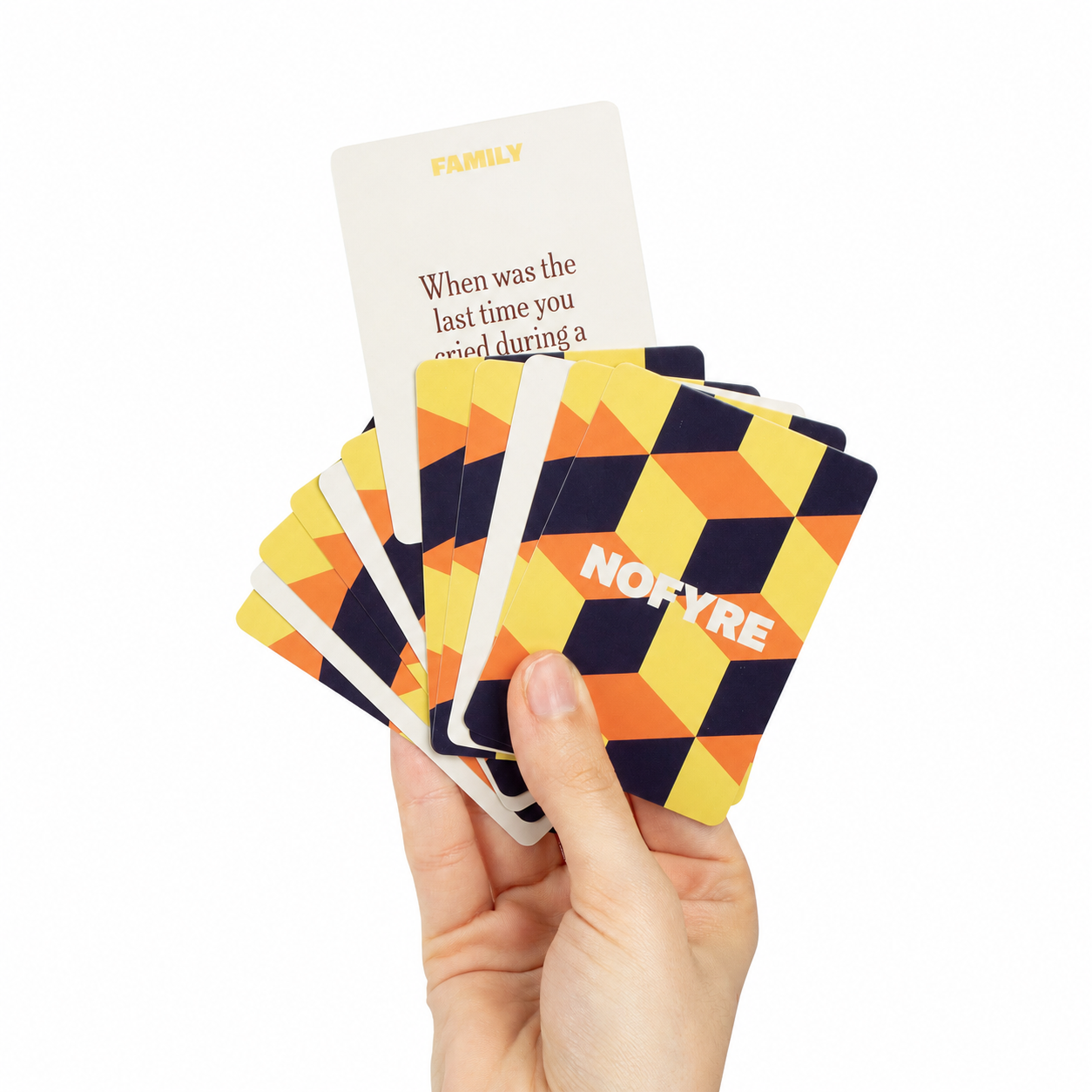
150 questions for the people who've known you longest — and somehow still have things they've never told you.
Couldn't load pickup availability
 Ships within 24 hours
 30-Day Returns

Real Tables, Real Nights


"Four generations at the table on Thanksgiving and we got through maybe nine cards. My grandmother told a story my mother had never heard. My mother is sixty-three."
What's inside
What's inside
- 150 conversation cards (2.5" × 3.5", 350gsm, matte finish)
- A rigid two-piece keepsake box — not a flimsy tuck box
- One card explaining how to play. That's the entire rulebook.
Who it's for
Who it's for
Families with adults and older teens (14+) at the table. Parents, grown children, siblings, in-laws, grandparents.
Holiday dinners that run out of things to say by dessert. Adult siblings who see each other twice a year. Anyone who's realized their parents had an entire life before them and never got around to asking about it.
This is not a kids' product.
How to play
How to play
Pull a card. Everyone answers — including whoever pulled it. Then follow wherever it goes.
No passing on the first question. That's the only rule, and it's the one that makes the whole thing work. It's also the one the teenager at the table will test first.
Will it work with a family that doesn't talk about feelings?
Will it work with a family that doesn't talk about feelings?
That's exactly who it's built for.
The first cards in the deck are the easy ones on purpose — funny, low-stakes, nobody has to be vulnerable to answer. By the time it gets real, the room has already warmed up and nobody noticed the shift.
Nothing in the deck asks anyone to open old wounds. There is no card about the thing your family doesn't discuss.
Is it a good gift?
Is it a good gift?
It's one of the few gifts that gets used before the wrapping paper is off the floor.
Ships in a rigid keepsake box, so it needs no wrapping. Add a gift note at checkout. And the 30-day guarantee covers you if it misses.


The Dinners Nobody Wanted To End
100,000+ families have used it to turn a normal Sunday into the one everyone still brings up.
-

Learned something about my dad at forty-one
We've had dinner every other Sunday for eleven years. Pulled a card about the scariest thing he'd ever done and got a story about a job he took in 1979 that I had never once heard about. Eleven years of Sundays.
-

My teenager put the phone down
I bought it with low expectations. Fifteen minutes in my sixteen-year-old was arguing with her brother about a question and hadn't looked at her phone once. She asked if we could keep going after everyone else left the table.
-

Bought one for each of my sisters
Used it at our mother's eightieth. There were nineteen of us and we ran it for two hours. Three of my cousins asked where I got it before they left. I ordered four more that night.


EVERY FAMILY HAS A SCRIPT
Same seats. Same four topics. Someone asks about work, someone asks about the drive, then it's the weather. Ten thousand dinners with these people, and most of what you know about them you learned before you turned twelve.
One deck on the table breaks the script. Not with some big emotional moment — with a question nobody ever thought to ask.
Why It Doesn't Get Old After One Night
The most common worry is that you'll play it once and shelve it. Here's why that doesn't happen.

What makes Nofyre different?

|
Others | |
|---|---|---|
| Works across generations | ||
| No rules, no scoring | ||
| Rigid gift box | ||
| Nothing that opens old wounds | ||
| 30-day guarantee |

Frequently Asked Questions
Do we have to sit down for a long time?
Do we have to sit down for a long time?
No. One card at dinner is enough.
Most families pull three or four and the night takes it from there. There's no session length and no "finishing" the deck.
What if my family thinks it's cheesy?
What if my family thinks it's cheesy?
That's the most common worry, and it usually dies on the first card.
The opening questions are funny, not sincere. Nobody has to be vulnerable to answer one. By the time it gets real, nobody's noticed the shift.
Are the questions actually good, or generic?
Are the questions actually good, or generic?
Every question was written and cut by hand. Anything that could be answered in one word didn't make it in.
The test we used: does the answer pull a story out with it? If not, it got cut.
We see each other every week. Will anything actually be new?
We see each other every week. Will anything actually be new?
Close families are where this works best.
You already know the facts about each other. These questions aren't about facts you're missing — they're about the ones nobody thought to ask. Most people find something new in the first ten cards.
What if someone refuses to play?
What if someone refuses to play?
It happens, and it usually doesn't last.
Nobody has to hold the deck or run anything. People who sit out for the first few cards tend to answer the fourth or fifth one without being asked. The rule about not passing only applies once you're in.
Can we use it over a video call?
Can we use it over a video call?
Yes. One person holds the deck and reads.
Works over FaceTime, Zoom, or a speakerphone in a car. A lot of people buy it specifically because their family is spread across states.
How many people can play?
How many people can play?
Three to twelve works comfortably.
Above twelve, split into two groups — the deck splits fine and both halves work. Large holiday gatherings usually run it in two rooms.
What ages is this for?
What ages is this for?
14 and up.
The questions are written for adults and older teens. This is not a kids' product and we don't recommend it for younger children — the Kids Edition is built for that.