


Life Story Edition
Life Story Edition
150 questions that get your parents talking about their own life — the years before you existed, and the parts they never bring up on their own.
Couldn't load pickup availability
 Ships within 24 hours
 30-Day Returns

Real Kitchens, Real Afternoons


"I thought I knew my dad's life. Two hours in he told me about a job he had at nineteen that nobody in the family had ever heard of. My mother was sitting right there and she didn't know either."
What's inside
What's inside
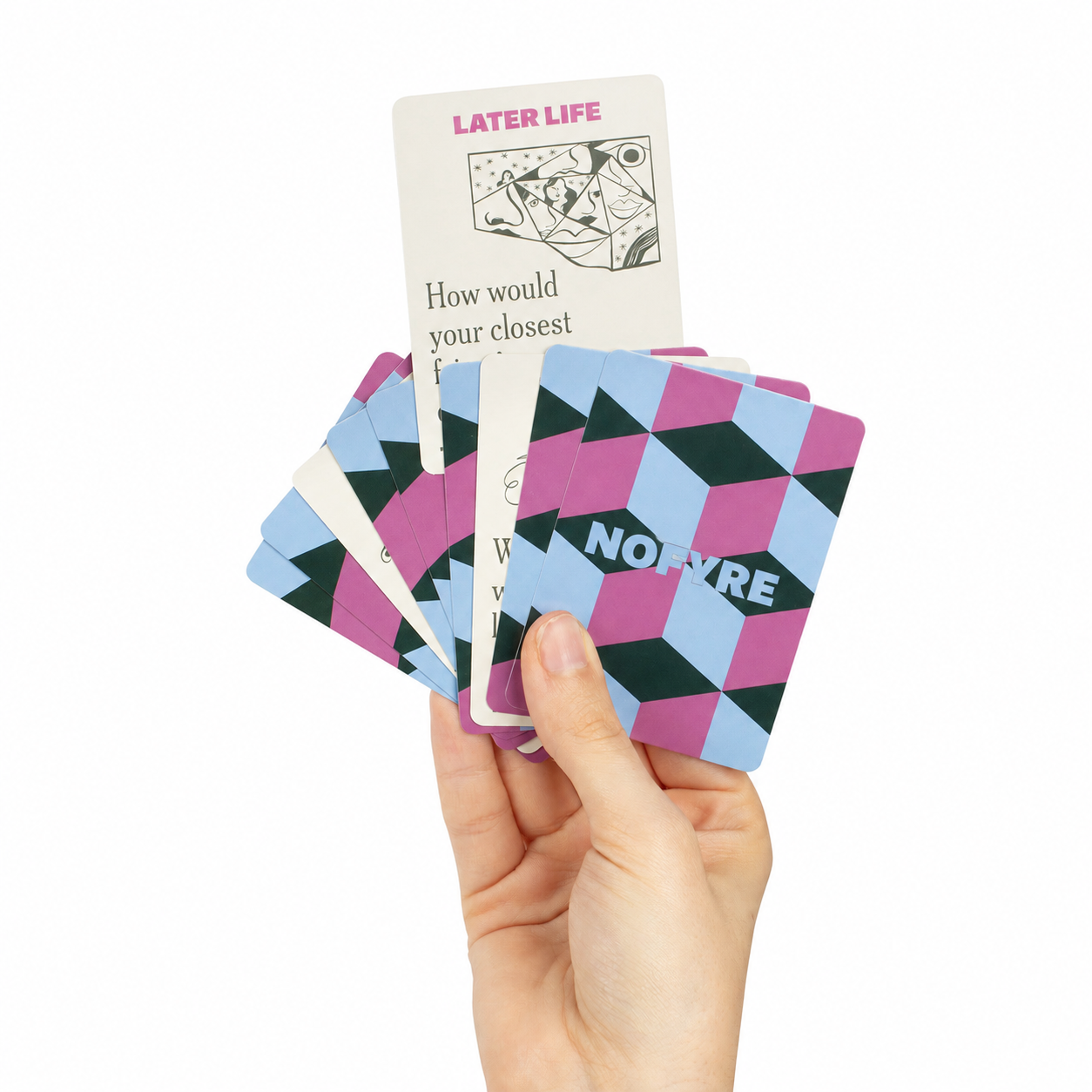
150 conversation cards (2.5" × 3.5", 350gsm, matte finish)
Sorted into three eras — Early Life, Mid Life, Later Life — so you're not jumping around a lifetime at random
A rigid two-piece keepsake box — not a flimsy tuck box
One card explaining how to run it. That's the entire rulebook.
Who it's for
Who it's for
Anyone who's realized they know their parents as parents, and not much else.
Adult children who've been meaning to sit down and do this for years. Grandchildren who want it in her own words, not secondhand. Families spread across three time zones who get four days a year together.
Written for adults. Not a kids' product.
How to run it
How to run it
Pick an era and pull a card. They answer. You ask the obvious follow-up.
The only rule is that you don't move on too fast. The first answer is almost never the story — it's the summary. The story is in the second answer.
What if they don't talk about themselves?
What if they don't talk about themselves?
That's most parents, and it's what the order of the deck is built around.
Early Life cards ask about places and objects — a childhood home, a first job, what the kitchen smelled like on a Sunday. Concrete things are easy to answer and reveal nothing. The questions that go deeper sit later in the deck, and by then they've been talking for half an hour and have stopped noticing they're being asked anything.
Is it a good gift?
Is it a good gift?
It's one of the few gifts that gets used the week it arrives — usually by the person who gave it.
Ships in a rigid keepsake box, so it needs no wrapping. Add a gift note at checkout. The 30-day guarantee covers you if it misses.


The Afternoons People Wish They'd Had Sooner
100,000+ people have used it to find out something they'd been wondering
about for thirty years.
-

I never knew how to start
Every time I visited I meant to ask him about his life and every time we talked about the car and the weather instead. First card broke it open. He talked for two hours. I didn't say twenty words.
-

We did it over the phone
She's in another state and I see her twice a year. We do four cards every Sunday call now. I've learned more in three months than in the last decade.
-

Bought it for my mother, ended up using it on her
Got it as a gift for her to use with my grandmother. She opened it, read one card out loud, and the three of us sat there until it got dark.


YOU KNOW THE PARENT. NOT THE PERSON.
You know his job, his opinions, and the same four stories he tells every Christmas. You don't know what he was afraid of at nineteen, or what he wanted before he settled for what he got.
Nobody volunteers that. It only comes out if somebody asks — and "tell me about your life" is not a question anyone can answer.
These are 150 questions small enough to answer.
You Don't Have To Do It All In One Sitting
The most common worry is that this turns into a project nobody finishes. Here's why it doesn't.

What makes Nofyre different?

|
Others | |
|---|---|---|
| Sorted into life stages, not shuffled at random | ||
| Opens with easy questions on purpose | ||
| Written for one-on-one, not a party | ||
| Built to work over a phone call | ||
| 350gsm cards in a rigid keepsake box |

Frequently Asked Questions
My dad doesn't talk about himself. Will this work?
My dad doesn't talk about himself. Will this work?
That's exactly who it's built for.
The first cards ask about places and things, not feelings — a childhood home, a first job, what the neighborhood was like. Easy to answer, nothing to reveal. The personal questions sit deeper in the deck, and by then he's already talking.
Won't it feel like an interview?
Won't it feel like an interview?
Only if you read the cards like a list.
Pull one, let him go off-topic, ask the obvious follow-up. The card is the excuse to start, not the script. Most people put the deck down after the third question and never pick it back up that afternoon.
Can we do it over the phone?
Can we do it over the phone?
Yes. One person holds the deck and reads.
Works over FaceTime, Zoom, or a speakerphone in the car. A lot of people buy it specifically because they live in a different city.
How long does it take?
How long does it take?
A first sitting usually runs about an hour and covers ten to fifteen cards.
There's no finishing the deck and no schedule. Some families do one card at Sunday dinner and stretch it across a year.
Are the questions actually good, or generic?
Are the questions actually good, or generic?
Every question was written and cut by hand. Anything that could be answered in one sentence didn't make it in.
The test we used: does the answer pull a story out with it? If not, it got cut.
Should I record it?
Should I record it?
Most people do. A phone voice memo on the table is enough — nobody performs for it after the first minute.
You don't have to. Plenty of families just have the conversation and leave it at that.
What ages is this for?
What ages is this for?
Written for adults. It works with teenagers asking grandparents, but the questions assume an adult's attention span.
Not a kids' product.